Products List
-
big fireclay bottom blocks
Description: Using big vibrating table and adopting special castables, the company produces furnace l...

-
fire clay bricks
Description Fireclay bricks are the most widely used refractories made from clay minerals. It can be ...
Refractory Knowledge
-
Silicone brick tips
Silica bricks are acidic refractory materials, strong resistance to acid slag corrosion, and its ther...

-
Mullite insulation brick
The mullite insulation brick is a high alumina refractory material mainly composed of mullite (3Al2O3...

-
The Development of Refractory Brick
In recent 20 years, due to the implementation of large-scale blast furnace in iron and steel industry...

-
Brief analysis of porosity and water absorption of refractori
What is the definition of the porosity of refractory materials and what is the basis for determinatio...

News Center
-
A Brief Analysis of Boiler Masonry and Its Function
Generally, small boilers are installed quickly and do not need to be built on site. For power plant b...

-
Factory Directly Supply With Popular Refractory Bricks in Ch
The use of kilns is inseparable from refractory bricks, but if the details of refractory bricks are n...

Physical Properties of Refractory Brick
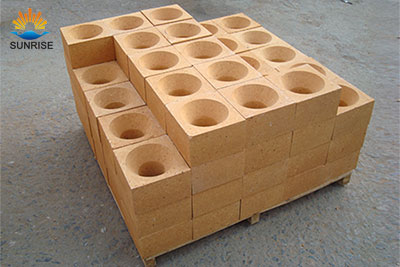
The macrostructure of fire clay insulation brick is a nonhomogeneous body composed of solid and gaseous pores. Stomata is an important factor affecting the performance of products at room temperature and high temperature, especially in high temperature conditions, making the product of the external erosion resistance greatly reduced. The reason of stomatal formation is: leaving space after material moisture removed, raw material calcination is not sufficient, and some decomposition of the salt is completely decomposed, should be burning ingredients for complete burning, composition is not uniform, shrinkage is not uniform when high temperature firing and so on.
But in some light insulation products production, people also introduced a number of more distribution uniform stomata. The presence of stomata directly affects the porosity, water absorption, bulk density, air permeability of refractory material and other indicators.
1. Porosity
The pores in the refractory material can be divided into: closed pore, closed in the product does not communicate with the outside. Open pore, one end closed, the other end connected with the outside, can be filled with fluid. Through pore, through the two sides of the product, can pass through the fluid.
2. Water absorption
The water absorption is the ratio of the mass of water absorbed by the entire opening of the product to the mass of the dried sample. Because the water absorption test method is simple, it is often used in the production practice to identify the raw material calcination quality. The better is the calcined material, the lower is the water absorption value.
3. Bulk density
The definition of bulk density is the ratio of the dry weight of the product to the total volume, also known as the volume weight. The bulk density intuitively reflects the degree of density, which is an important measure of the quality of the refractory material. However, in the production of lightweight insulation products, in order to reduce the heat capacity and thermal conductivity, people also use various means to reduce the bulk density of products.

If you have any needs our help or are interested in our products, you can click online advisorychat with us online, or call our customer service telephone: 0086-0371-63838939. We will sincerely serve for you!